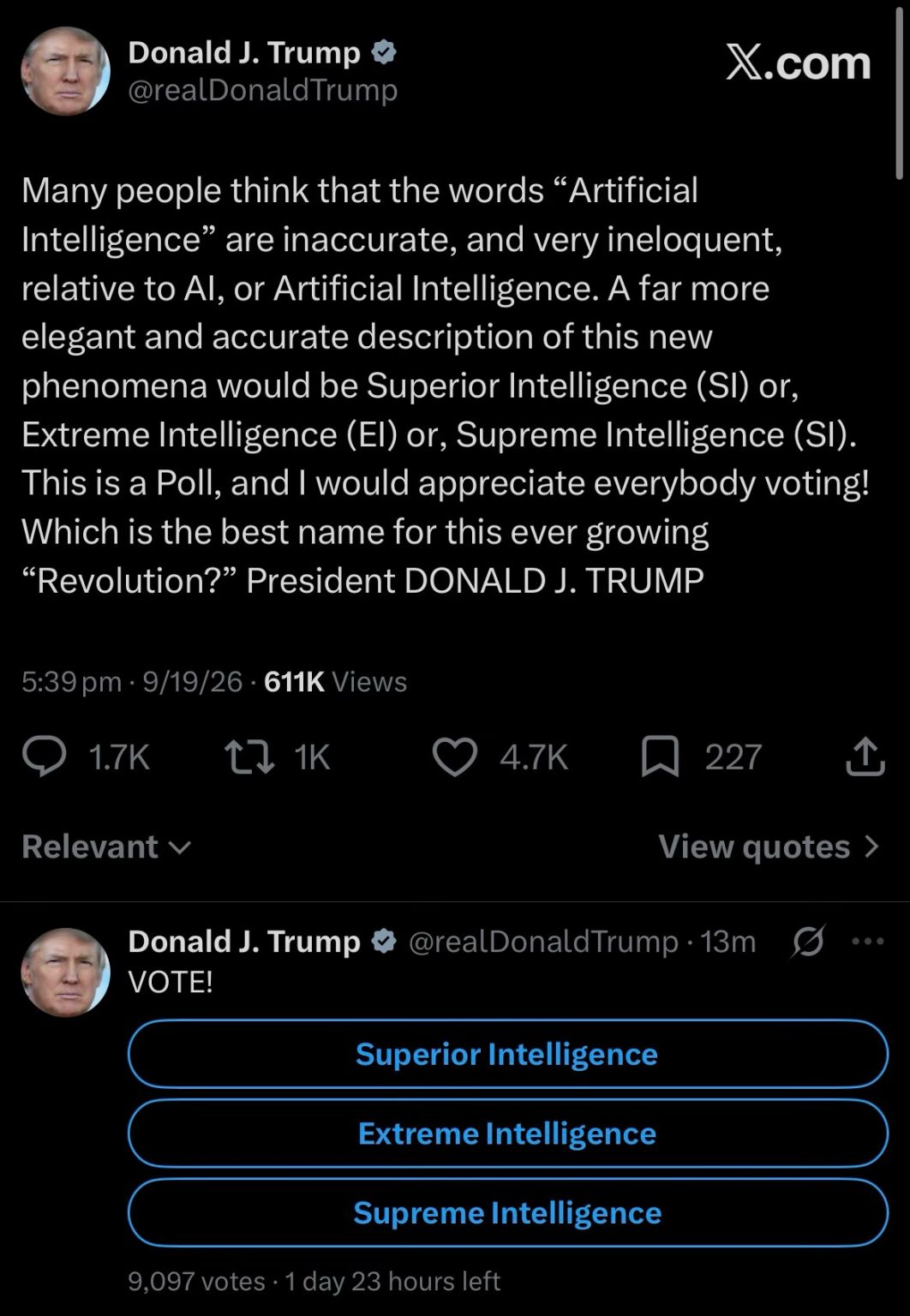
Donald Trump wants a better name for artificial intelligence. On Saturday he called the words “inaccurate, and very ineloquent”, and asked his followers to vote between Superior Intelligence, Extreme Intelligence and Supreme Intelligence.1 He is right that the name is wrong, and I have a better option than any of his three.
Let’s call it Machine Intelligence.
McCarthy Wanted a Better Name Too
John McCarthy coined the term in his 1955 proposal for the Dartmouth summer workshop, and he later told Noel Sharkey that he wished he had called the field “computational intelligence” instead, although he accepted that his choice had probably drawn more people to the subject.2 The field has also dropped the name under pressure before. When the funding dried up, researchers called their work informatics, knowledge-based systems or cognitive systems to keep the grants coming, and IBM later sold Watson as “cognitive computing” to get away from the fear attached to AI.3 None of those names changed how anything worked, and none of them stuck.
“Computational” is no better than “artificial”, because it is long and awkward to say. “Machine” is clearer and more visceral, and it will get more accurate, because this intelligence will be embodied in robots before too long. How soon depends on whether we get export controls or a deal, and I wrote in April about how governments take control of a technology once the political panic sets in.
Artificial Implies Fake
“Artificial” implies that the intelligence is not real. Biology has had the monopoly on intelligence until now, so we have conflated the two for our entire existence and built our assumptions on top of that. That monopoly is over. I suggested Machine Intelligence in a WhatsApp group with other AI experts, and I have not heard a better name. It covers any intelligence produced by machines, and says nothing about real or fake or about biology. The term has a history of its own too: Donald Michie convened the first Machine Intelligence Workshop at Edinburgh in 1965, and the university founded a Department of Machine Intelligence and Perception the year after.4
Trump has more important work to do than naming things. He could make an information-sharing deal with China that lets them catch up to the level of OpenAI’s Astra, in return for slowing further work.5 UN inspectors would get access to AI labs worldwide, and he could share a Nobel Peace Prize for it. That deal matters far more than what we call any of it. But he is right about the name, and “artificial” has to go. Once it is gone, we can no longer get away from the fact that machine intelligence is real, and here to stay.
-
Trump posted the poll on Truth Social and on X on 19 September 2026. The Hill and TechCrunch both covered it. A day later he dropped Supreme Intelligence, “probably because of its relationship to the Supreme Court”, and restarted the vote with the other two. ↩
-
Sharkey said this in the BBC obituary of McCarthy in 2011. McCarthy himself was less sure, and told CNET in 2006 that he could not have used “computational” in 1955, because the idea that computers would be the main vehicle for the work was a minority view at the time. ↩
-
The Wikipedia article on the AI winter lists the alternative names and notes that they “helped to procure funding by avoiding the stigma of false promises”. Ginni Rometty explained the Watson choice to Bloomberg Businessweek: “The world calls it AI. There’s so much fearmongering about AI.” The quote is in Stephen DeAngelis’s piece on cognitive computing. IBM went back to saying AI within a few years. ↩
-
The Machine Intelligence series of workshops and volumes ran for decades under Michie as editor. The University of Edinburgh’s history of its early AI years covers the department. ↩
-
I first sketched this deal on LinkedIn. ↩