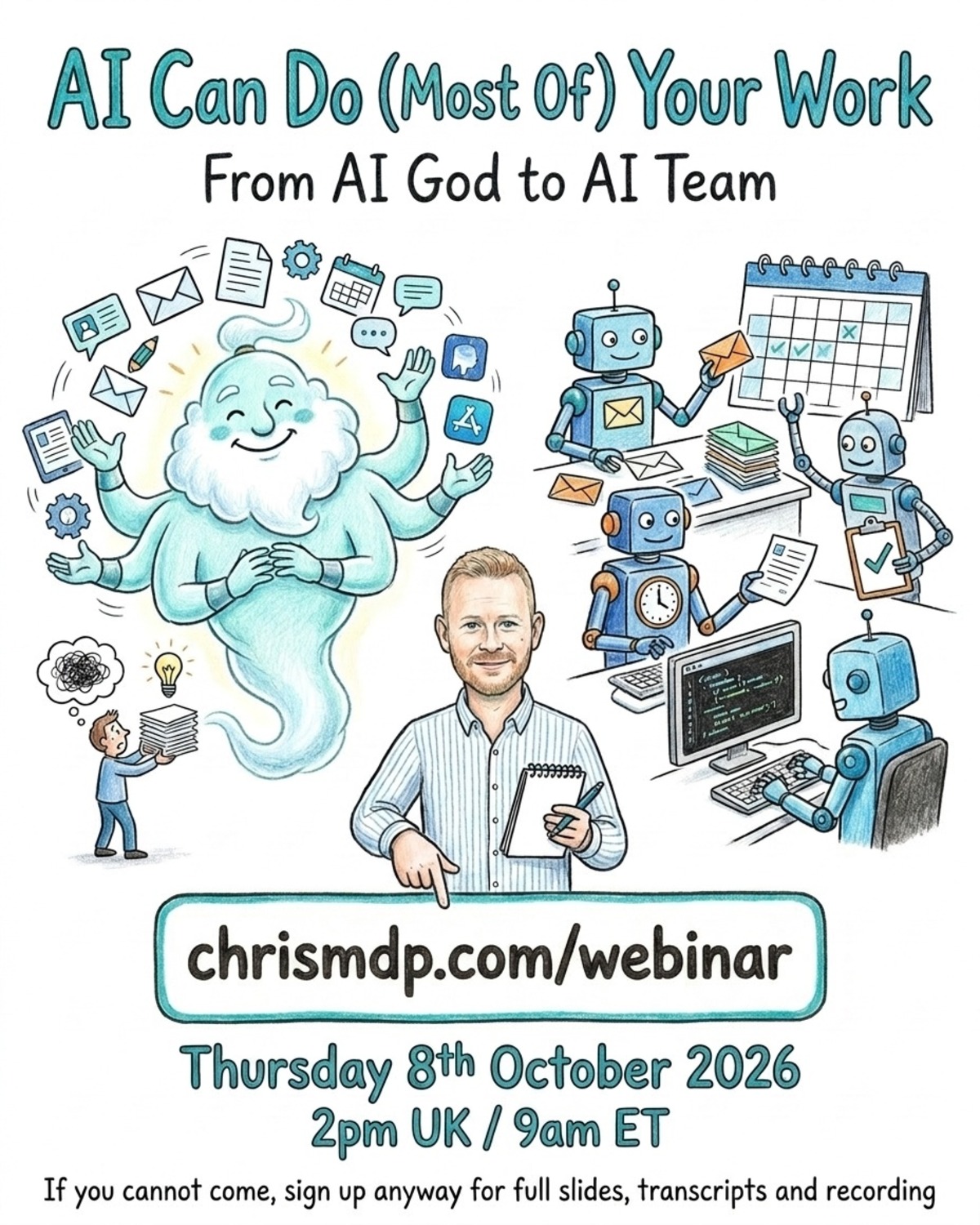
On 8 October 2026, I gave a webinar about which parts of your work to hand to AI. AI can now take a decent crack at almost anything you give it. In March I showed how I gave it all my context so it could. Since then I have learned that the harder question is which work is still yours.
One AI that knew everything
I run most of my business with AI. I had built up about 70 skills, nearly all working over one vault: every note, meeting transcript, saved article and client note, synced across my laptop, phone and a server. It was a thing of beauty.
So I asked it for everything. Client positioning, proposal wording, what to prioritise this week. It seemed to know my situation better than I did, and it never got lazy. What came back was plausible, and average. I read every draft, winced, and rewrote it. I had become a mindless human with a big rubber approval stamp, stamping out mediocre blog posts.
The thinking I had handed over was the work I am paid for, and the work I enjoy. AI is built to converge on an answer, and good strategy needs you to diverge first. One AI that sees everything is also a security risk, and blends client and personal signals into mush. I wrote about this in I Don’t Want an AI God.
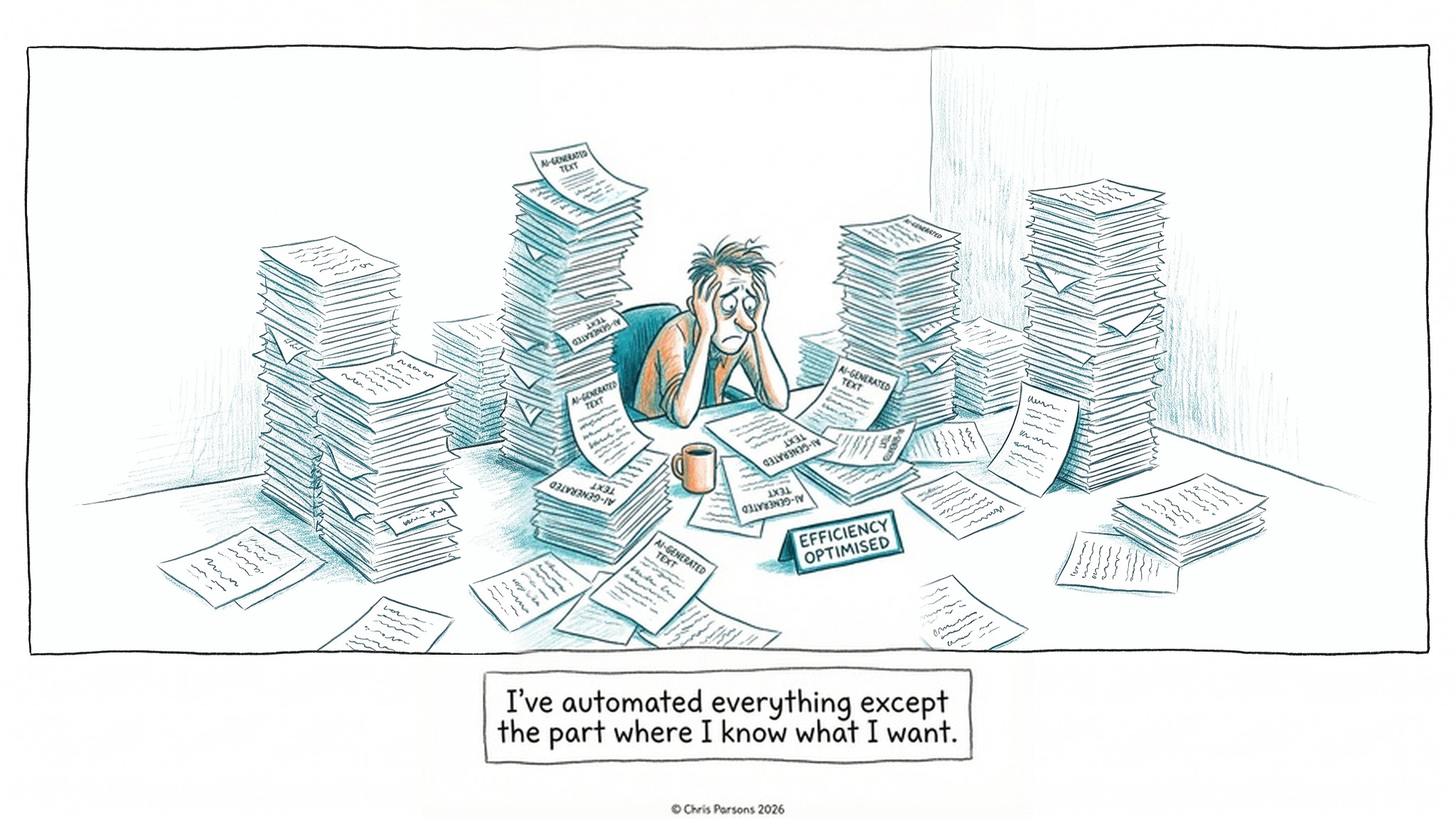
We trust fluent writing, even when it is wrong, and the latest models write very fluently. Addy Osmani calls it cognitive surrender: the moment you stop forming your own answer.1
What stays with you
Tara Seshan, who leads product for Codex and ChatGPT Work at OpenAI, names three things that stay with us: relationship and connection, expression, and accountability.2
Relationship and connection. My friend Hywel Carver has a good test: would you be comfortable telling the other person you used AI? Getting help appealing a parking fine is fine. A letter to your mum while she is in hospital is not. I use AI for quick “thanks, I would love to set up a call” replies all the time, but I always tweak them and I never let it send for me.
Expression. Some writing just carries information, such as a policy turned into a handbook. If the ideas are already formed, let AI write it. Other writing is your personal creative expression: your art, your personality on the page. That has to come from you.
Accountability. Sophie Alpert’s AI writing policy at Clay says to stand behind every line.3 “AI wrote that, just ignore it” is not an answer. If you could not be bothered to write it, why should anyone bother to read it?
Tobias Lütke calls unchecked AI text a slop grenade.4 One mistranscribed name in a meeting transcript gets picked up by other agents and spread across a whole organisation. So every transcript now goes first to an agent that checks it against my vault and asks me about anything odd, before other agents see it.
Goal, effort, check
Everything else I hand over, and it no longer takes clever prompts. Boris Cherny, who created Claude Code, said this week that prompts mattered a lot in the Sonnet 3.5 days. Now you tell the model what you want, how much effort to spend, and how it should check it did the right thing.5
The goal is the hard part, because often I do not know what I want yet. So I dictate, ramble, and ask the AI to question me one question at a time and keep its own view to itself. I want to work out what I think first.
This webinar is an example. At 9:30 that morning none of the slides existed. The AI pulled my notes from the vault and questioned me, then produced an outline. The flow was wrong, so I wrote the outline myself. The AI replied “that’s so much better than what I had” and rebuilt everything around it. Too right!
Then I give feedback on something I can see. My slides have a little review box where I comment on any slide, and the AI fixes everything in one go. You do not need my slide system. Claude artifacts and Codex sites make throwaway review pages in minutes, and they beat going back and forth in a chat box.
Writing
For about six thousand years, writing was proof of thinking. That stopped being true a couple of years ago. AI is brilliant at turning thoughts from one form into another, so it will happily turn a couple of thoughts into a whole blog post that still contains only a couple of thoughts.
One attendee asked: if your couple of thoughts are so easy to expand, did we need you to have them in the first place? Probably not. That post should have been a two-line LinkedIn post, or it needed more thinking.
So now the AI pulls up what I already know, and I write the argument myself. My first drafts are terrible. I do not enjoy it, but that is where the value gets added. Then AI tidies the structure, adds references, checks facts and points out holes in the argument. (I Think Whilst) Writing With AI walks through the whole process.
Coding
I delegate most of my coding now. I talk to one coordinator about what we are building, and it hands bounded jobs to worker agents and reviews what comes back.
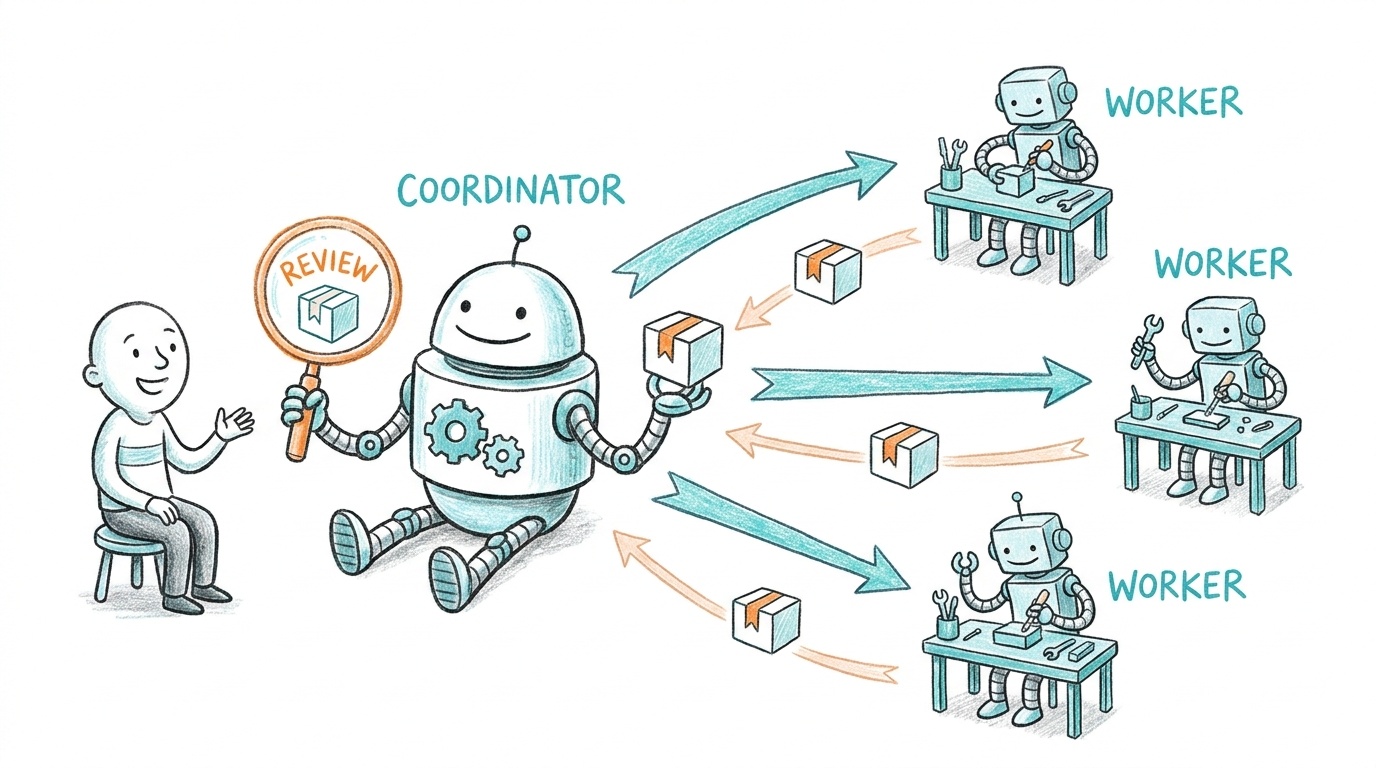
My rule is to ask who will look at the result. If a test can check it, I delegate the whole thing. If a person has to see it, I build it interactively, often in a Claude artifact where I can comment on the screen.
One attendee asked about AI making huge “god objects” and five-thousand-line files. It happens. Good rules help, so does using only the latest models, and so does getting an AI to review the code adversarially. I care about the data model, the security model, overlapping abstractions and duplicated state, because they breed bugs, and about test coverage. I care much less about method length, or even which language it is in, because AI does the reading and writing.
When a game I was writing had a strange bug, I had the AI draw me the whole map instead of reading the code, and spotted which scenes were broken. (I Am No Longer) Coding With AI has more.
This is exhausting. I now spend the day on high-level judgement, across three or four projects where I used to run one. Another attendee explained why: AI does the fast System 1 work, so what is left for me is all slow, effortful System 2 thinking.
A team, not a god
For repeatable jobs, I have moved from one big AI to a team of small agents, each with one job. I have run them in Telegram for months, and I am now rebuilding them in Slack as 27agents. Em triages email, Miriam is a productivity coach, and Paolo is a product associate who also gets the code done. Each has a small remit, so you know what it can reach and how much damage a conversation can do.
The big players are reaching the same idea from different directions:
- OpenAI dots gives you one primary dot that does everything. Single-job specialist dots exist only in enterprise pilots that OpenAI’s engineers set up with the customer.6
- Grok Bot gives you a team of bots, but they all share one computer, and xAI says separate bots are not separate security boundaries.7
- Claude Tag puts Claude into Slack, and the channel decides which systems and data it can reach.8
- Shopify’s River is a Slack agent that only works in public channels and now co-authors one in eight merged pull requests.9
Most of these still leave you to work out what to ask and how to set up each bot. Shopify has a platform team do that for everyone, and so does 27agents.
A motor on each machine
Right now AI feels like the early days of electricity, with everyone wiring up their own generators and batteries at their desks.
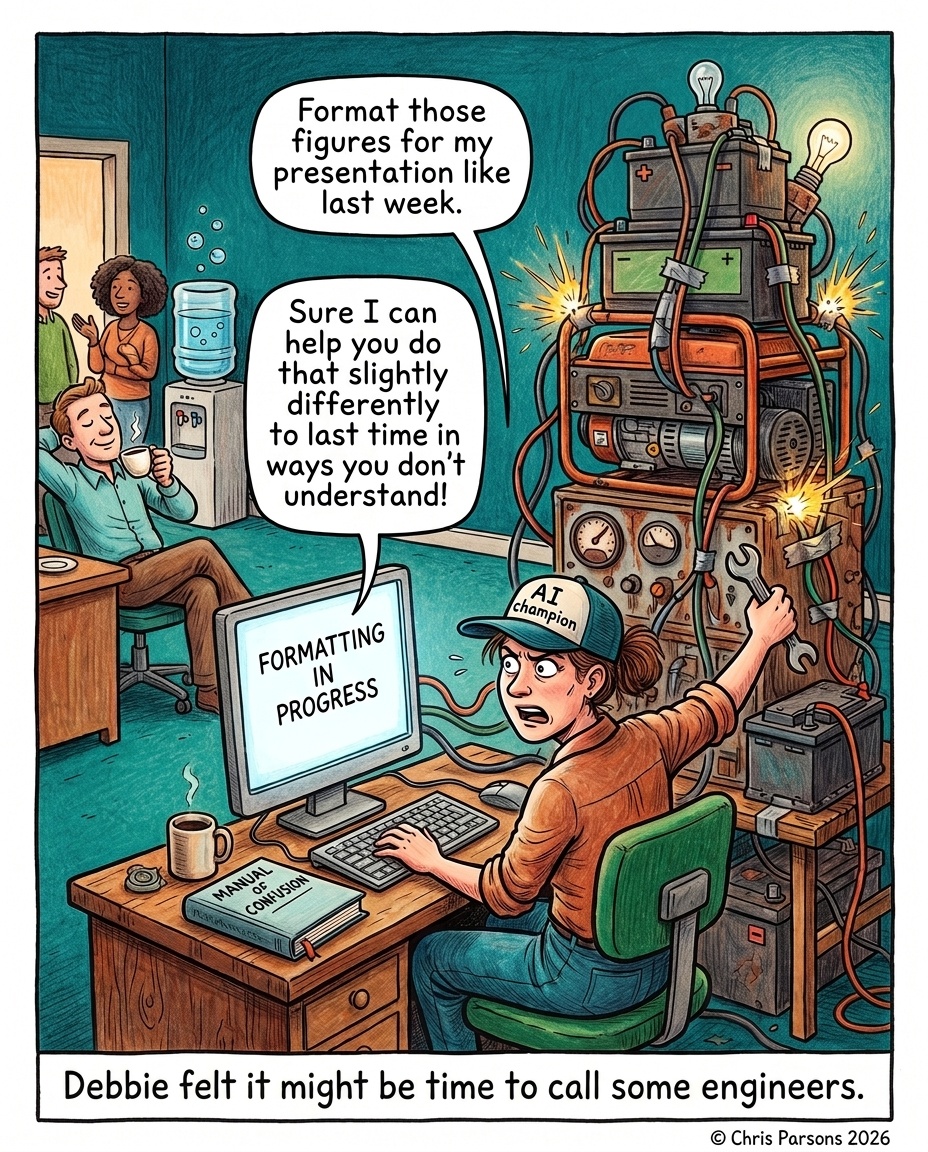
Paul David’s “The Dynamo and the Computer” shows that factories which put one big electric motor where the steam engine had stood gained very little.10 They kept the same shafts and belts. The gains came in the 1920s, about forty years after the first power stations, when factories put a small motor on each machine and rearranged the floor around the work.
One big motor driving everything is the AI god. A motor on each machine is the team of single-job agents.
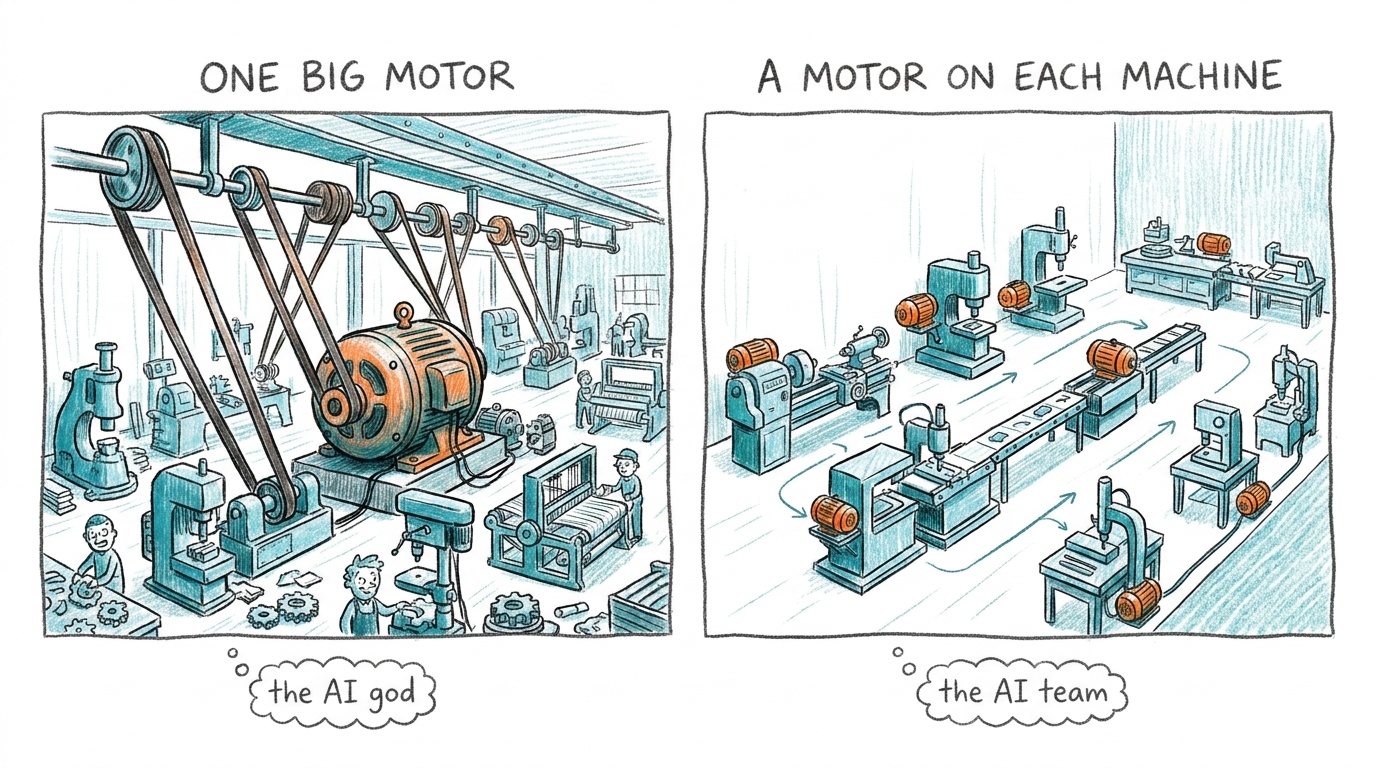
Electricity won when nobody thought about it any more. AI will get there the same way: small jobs, wired into the tools people already use, with a few specialists doing the wiring so everyone else does not have to.
Questions from attendees
One attendee asked how this works across a whole enterprise, and whether bots can be limited to certain jobs. They can. Copilot and Claude both have plenty of permission settings. Lock things down too far and you get generic answers, because the AI cannot see your data. Lock down too little and it runs riot.
Another asked how junior staff can reflect as carefully as seniors. Juniors cannot yet spot average output. AI raises their work to average, then hits a ceiling. They learn fastest working alongside a senior who points out the slop, until they develop a healthy slop allergy of their own.
Two more great suggestions came from the chat. Teach juniors, and children, to use AI to ask them questions rather than to give answers. And courses in systems thinking and critical thinking help. I have gone back to writing 750 words every morning for exactly that reason.
Key takeaway to remember
AI can do most of your work, but one AI that does all of it makes your work average and less safe. Keep relationship, expression and accountability for yourself. Hand the rest to small agents with one job each, and spend the time you get back thinking.
One thing to try this week
Take a week of your work and sort each task into three piles. Information: reports, summaries, admin. Ideas you have already formed that just need writing up. And you: relationships, original thinking, anything you have to stand behind. Hand over the first pile, let AI help with the second, and keep the last for yourself.
Tools and resources
- The slides from this webinar
- I Don’t Want an AI God, on why one assistant with access to everything goes wrong
- (I Think Whilst) Writing With AI, my full writing process
- (I Am No Longer) Coding With AI, how I delegate code
- 27agents, the team of single-job agents I am building
-
Addy Osmani, Cognitive Surrender. ↩
-
Tara Seshan on Lenny’s Podcast: AI’s third era: the rise of persistent AI coworkers. ↩
-
Sophie Alpert, Clay’s AI writing policy, 19 August 2026. ↩
-
Tobias Lütke on The Knowledge Project podcast, as reported by Fortune: Shopify CEO says employees’ ‘slop grenades’ are making more work for everyone else. ↩
-
Boris Cherny on X, 6 October 2026. ↩
-
OpenAI, Introducing dots. ↩
-
SpaceXAI, Grok Bot overview. ↩
-
Anthropic’s Claude Tag announcement, 23 June 2026. ↩
-
Shopify Engineering, Under the River, 2026. ↩
-
Paul A. David, The Dynamo and the Computer: An Historical Perspective on the Modern Productivity Paradox, American Economic Review, 1990. ↩
Previous Webinars