In the late nineteenth century, J. P. Morgan, already one of the most powerful bankers in New York, wanted electric light before anyone else had it. So Thomas Edison’s people put a steam engine and generators in the stable behind his house on Madison Avenue, and ran the power to the house through a brick conduit under the yard.
Morgan was delighted. Every evening, as the sun went down, his machines roared into life and lit up the house. However, Mrs Brown next door complained that her whole house was shaking, and that the coal smoke was getting into her pantry and tarnishing her silver. Perturbed, Morgan wrote to the Edison company that the whole thing was “an outrage to me, as well as the neighbors”.
The engineers responded by padding the machines with rubber, and then proceeded to line the stable with felt and pile up sandbags. Then winter came, the snow melted over the warm conduit under the yard, and every stray cat in the neighbourhood gathered on it. Their constant yowling started a whole new round of complaints.1
Morgan asked Edward Johnson, one of Edison’s top people, to sort the system out. He fixed it by running new wiring under the library floor to contacts hidden in the legs of Morgan’s desk, so that his desk lamp worked without a trailing cable: the first “wireless power”.
However, some time later, while the family was at the opera, one of those contacts bent, sparked and set the library on fire. Johnson was summoned to a burned desk and a charred heap of rug. Morgan appeared in the doorway, looked at him over the top of his glasses and asked: “Well, what are you going to do about it?” Johnson said it was his own fault, and that he would make it perfectly safe. “Alright,” said Morgan, “see that you do.”
Despite these setbacks, Morgan persisted, and never ripped the system out: an early adopter to the core. He was proud of what he and Edison’s people had achieved, and he threw a reception for four hundred guests to show off his electric light, a symbol of the future.
AI is like 1880s electricity
This illuminating story is a good picture of where most organisations are with AI today. When electricity was a novelty, enterprising people stuck it into their homes and started fires, and factories did not quite know what to do with it.
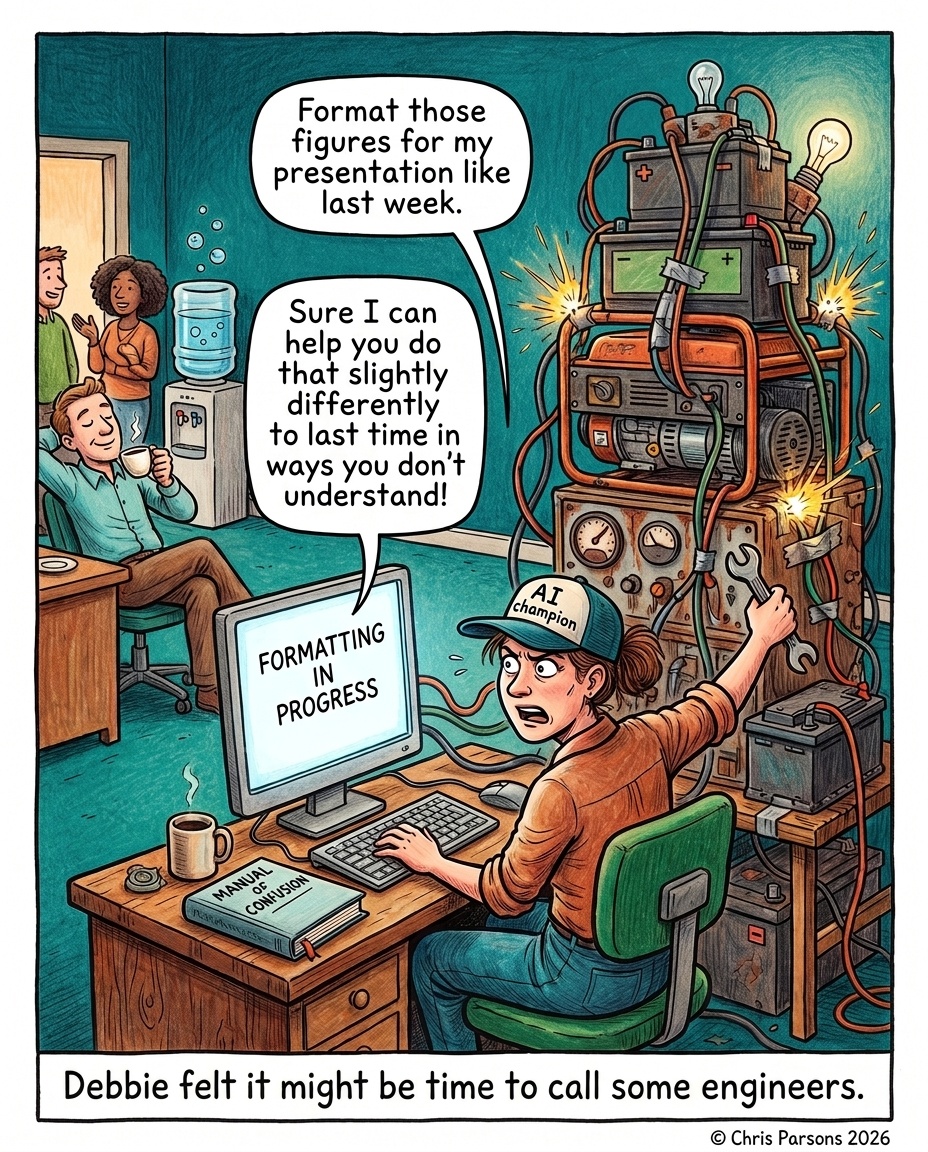
Companies now are the same. We are all running our own generators and wiring our own batteries at our desks. Every organisation has a few Debbies, the AI champions keeping it all running:
It works, after a fashion. People are having fun, reporting high individual levels of productivity, and it does appear that they are getting a bit faster around the edges. But every setup is custom and nobody else can maintain it. Sooner or later somebody will get hurt. Perhaps nobody will get fried or set on fire, but there will be lost work, data breaches and slop grenades, Tobias Lütke’s name for AI-written emails and code that people toss at each other without reading them.2
Some waste is fine early on. A little duplication or unnecessary token spend is how people learn what AI is for. We just cannot stay there.
Here are my seven predictions for how AI at work will change, based on these lessons from history.
Do not bet against the incumbents
In the 1880s Edison sold far more private plants than he built power stations: in 1886 there were 702 of his isolated plants in cellars, mills and hotels, against 58 central stations.3 Eventually the grid won anyway, on scale and price. In Chicago, Samuel Insull’s Chicago Edison charged 20 cents a kilowatt-hour in 1892 and 2.5 cents by 1909.4 In today’s money that is a fall from over seven dollars to about 85 cents, while the average American household now pays around 17 cents.5 Electricity got more than forty times cheaper, and it got there because we moved away from private generators.
AI will make the same move from private generators to a grid, and the question is who builds it. OpenAI and Anthropic are generator companies. ChatGPT and Claude are sold as a generator for your own cellar: powerful, but you have to learn to run them. Google and Microsoft own the buildings, because Workspace, Microsoft 365, Windows and Android are where people already work. They have a clear network effect and incumbent advantage, which puts them in the best position to be the people that put the sockets in the walls.
The work will be redesigned
Edison designed his first electric system as a better version of gas. The generating station took the place of the gas works, the mains were laid underground like gas mains, the wires inside buildings ran through the old gas fittings, and customers were metered just as they were for gas.6 It was a brilliant way to sell a new technology, because everyone already understood what a gas lamp did. It was also a very small idea of what electricity was for.
Factories made the same mistake at a bigger scale. The economist Paul David showed that factories which swapped their steam engine for one big electric motor gained very little.7 They kept the same shafts, the same belts and the same layout. The gains came in the 1920s, about forty years after the first power stations, when factories put a small motor on each machine and rearranged the whole floor around the work.
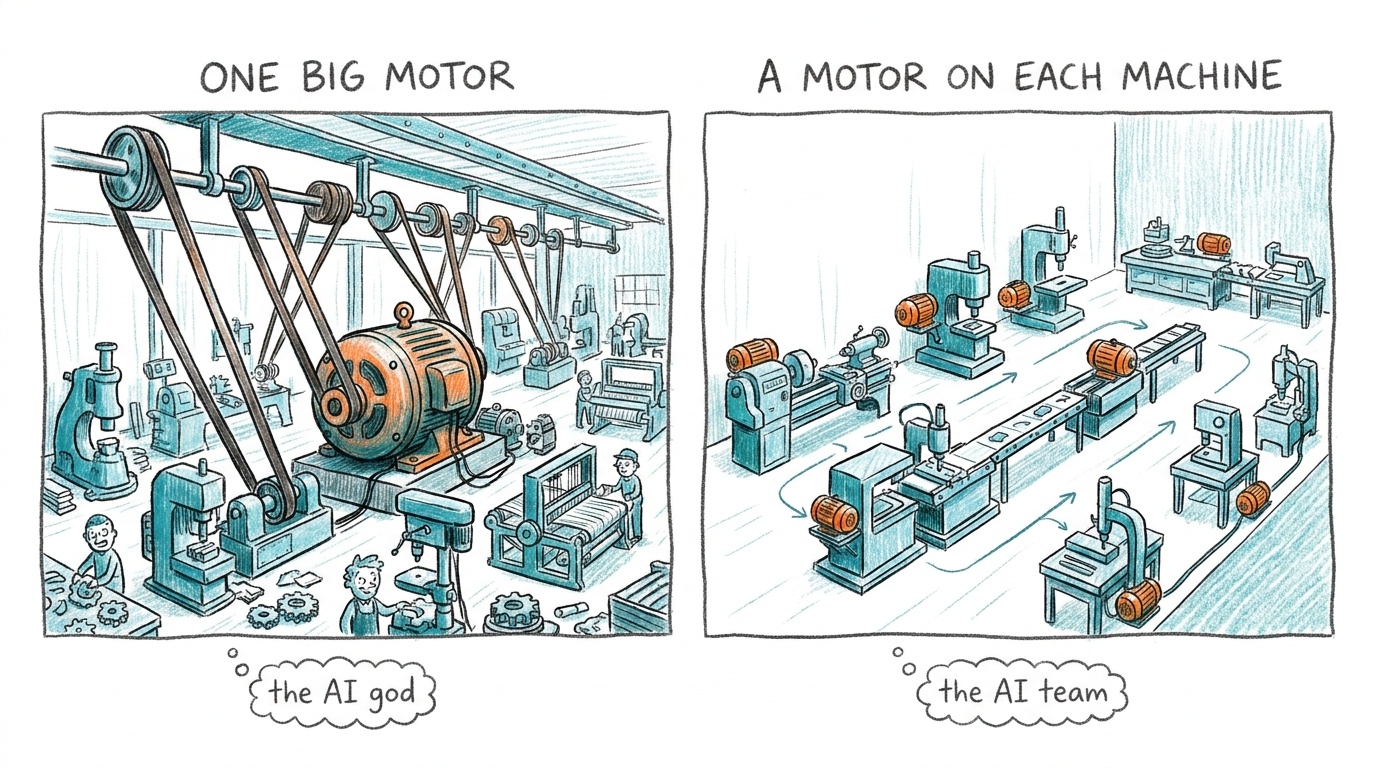
At the moment we are treating AI like that big motor. We hand a whole chunk of work to one AI and expect it to know everything. The bigger change will come when we break the work into smaller jobs, give each one a small agent with clear permissions, and plug those agents into the tools people already use. I have written about why I moved from one AI that does everything to smaller agents that each do one thing well.
Like solar panels, open models will transform AI
There is a twist in the generator story. You cannot build or run a GPT or a Claude yourself: those models are closely guarded, so you rent the power by the token from the company that owns the generator. Open-weight models are different. Anyone can download them and run them on their own hardware, even a powerful machine on a desk. Many of the best come from Chinese labs, such as DeepSeek, Qwen, Kimi and GLM, and I argued earlier this year that open models are now ready for real work.
That makes them more like solar panels on your roof. A small installation will not run a steel mill, but they are cheap, they keep getting better, and the power is made where it is used.8
Local models also fit the idea of a motor on each machine. A small agent with one narrow job rarely needs the biggest model in town. In my own work, a strong frontier model plans the job and checks the result, and cheap open models do much of the routine work underneath for pennies. I expect most organisations to end up with a mix: big models for the hard thinking, and their own local models for the everyday load, but we will see just how powerful local models get.
Regulation will come
Morgan’s library fire was not unusual. Early electrical installations caught fire often enough that the people paying for the damage got involved. In 1893 William Henry Merrill inspected the electrical installations at the Chicago World’s Fair, and in 1894 he founded what became Underwriters Laboratories, backed by fire insurers.9
AI will go the same way. There will be enough data leaks, wrong answers sent to customers and agents doing things nobody approved, and then standards for how this stuff gets wired in will follow. Whatever governments say, companies will demand them anyway, probably led by the insurers again.
For now, each organisation writes its own rules, and the best ones will come from people who have already been burned.
Engineers will become electricians
Nobody learned electricity to use a socket. Electricians did the wiring, and everyone else plugged in. Early on, electrical work was a strange new specialism, and you needed someone who really understood it to get light into your building without setting it on fire. Over time it became an ordinary, well-understood trade, and today an electrician is a phone call away.
The first electricians did not come from the steam engine room. They came from the trade next door: telegraph and telephone linemen, who already knew how to string a wire. Henry Miller, who helped found the American electricians’ union in 1891, started out on a crew stringing a telegraph line across Texas and then worked as a lineman for Western Union.10 Today’s AI engineers are coming from the same kind of place: software engineers, who already know how to wire systems together.
To most people, AI engineers look like expensive magicians, just as electricians did 130 years ago. They are the people who know how to wire a model into your systems and data, decide what an agent can see, and make it safe enough that everyone else can just use it. Like electricians, their trade will become an ordinary one, with standard parts and standard practices.
We can buy AI adoption
If you can rent agents from a company that has already done the wiring, do it. Most AI products today still hand you the wire. You get a general agent and have to work out what to ask, how to set up your own bots and what each one should be allowed to see, which is a bit like having to learn how a generator works before you can switch on a lamp. A few are starting to come wired in. Shopify built one internal platform so that any team can ship a new agent cheaply, instead of each team wiring its own.11
This is why I am building 27agents, a ready-made team of agents to handle the tasks you hate. Most jobs are a tangle of small tasks, and plenty of them are drudge work: triaging email, chasing actions, keeping track of who promised what. Each agent does one of those well, with clear permissions, so you know what it can reach and how much damage a conversation can do. The one-minute film below shows the idea:
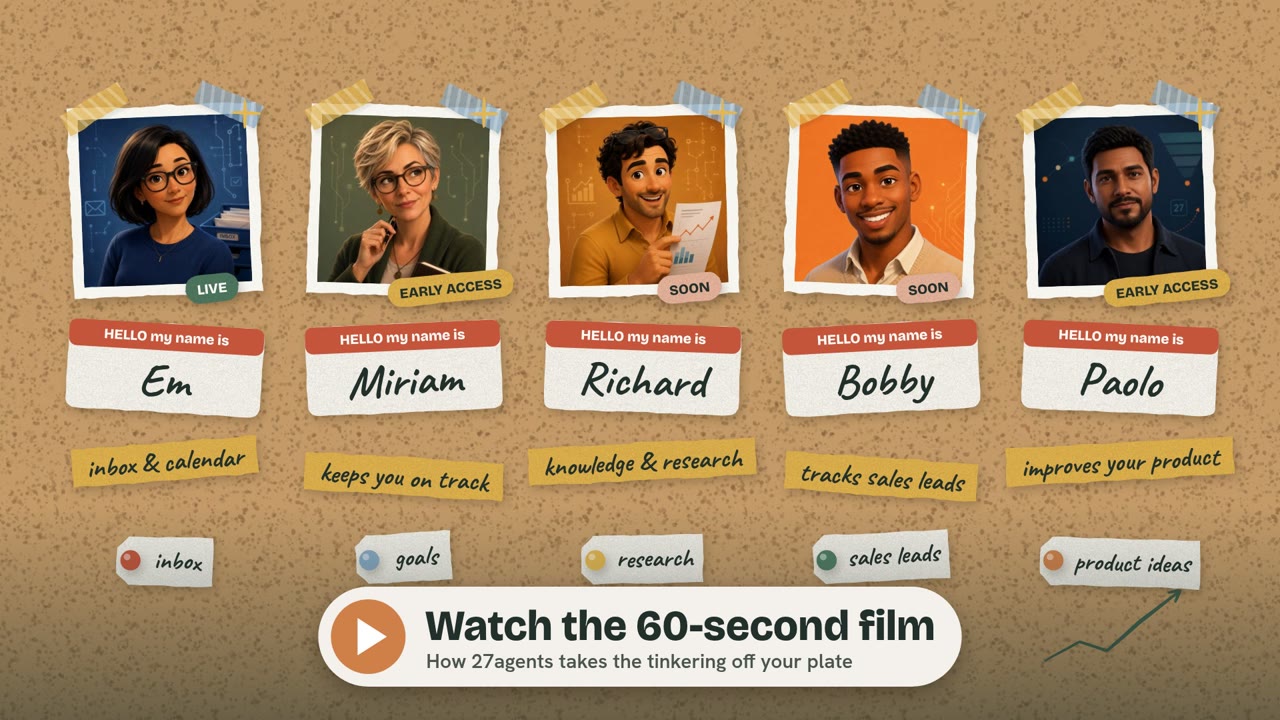
The agents do the boring bits, and the team gets to be the hero.
AI will become invisible
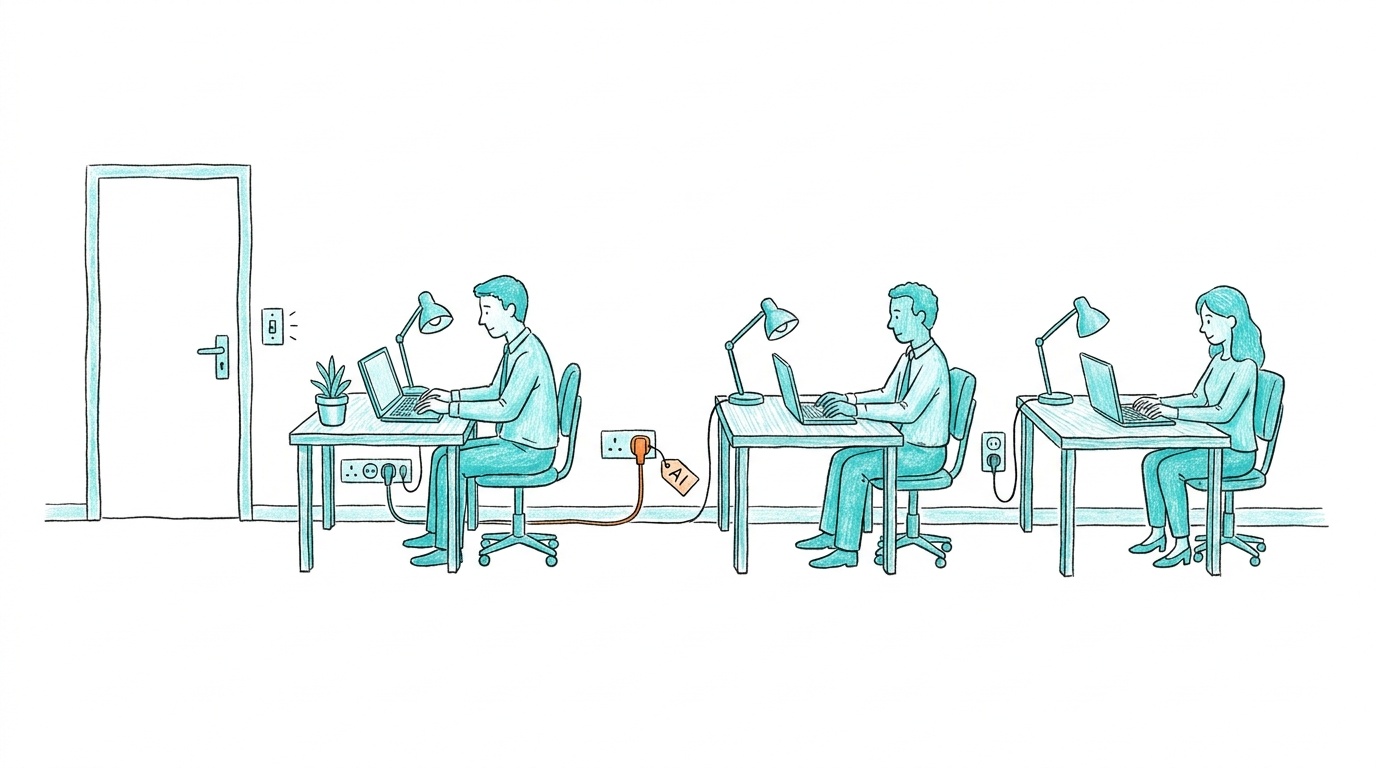
Eventually electricity became invisible. It is just part of the walls, and now we look around and wonder how any of this could be possible without it. Nobody a hundred years ago could have imagined how we use electricity now, and we cannot yet imagine most of what we will do with AI either. We only have hints.
But we will get there. At some point nobody will have to think about AI, in the same way that almost nobody thinks about electricity when they flick a switch.
Until then, ask what Morgan’s neighbours would have asked: who is doing the wiring at your place, and is it worth it?
-
Jill Jonnes, Empires of Light (2003), excerpted at Delanceyplace, including Edward H. Johnson’s account of the library fire. The Morgan Library also describes the noise, the smoke, the neighbours’ complaints and the desk fire: Preparing to Close. ↩
-
Fortune, Shopify CEO says employees’ ‘slop grenades’ are making more work for everyone else, 17 September 2026. ↩
-
Brian Potter, The Birth of the Grid, Construction Physics. ↩
-
Institute for Energy Research, Energy Pioneers: Samuel Insull. ↩
-
Converted with US consumer price inflation from 1892 and 1909 to 2025 dollars, using MeasuringWorth. Today’s price is the 2025 US average residential price of 17.3 cents per kilowatt-hour from the US Energy Information Administration. ↩
-
Smithsonian, Lighting a Revolution: The Edison System, and the Thomas A. Edison Papers, Conceiving the System. ↩
-
Paul A. David, The Dynamo and the Computer: An Historical Perspective on the Modern Productivity Paradox, American Economic Review, 1990. ↩
-
The parallel goes further than I expected: China made 86% of the world’s solar panels last year, including the ones on my roof. Open models raise the same questions cheap solar did. They are very good value, and some people worry about where they come from. Source: IEA PVPS, Trends in Photovoltaic Applications 2025: China produced 86.4% of the world’s solar PV modules in 2024. ↩
-
UL, Our History. ↩
-
IBEW, Remembering Henry Miller, and the union’s own history, which traces it to the Electrical Wiremen and Linemen’s Union founded in St Louis in 1890. ↩
-
Shopify Engineering, Under the River, 2026. ↩