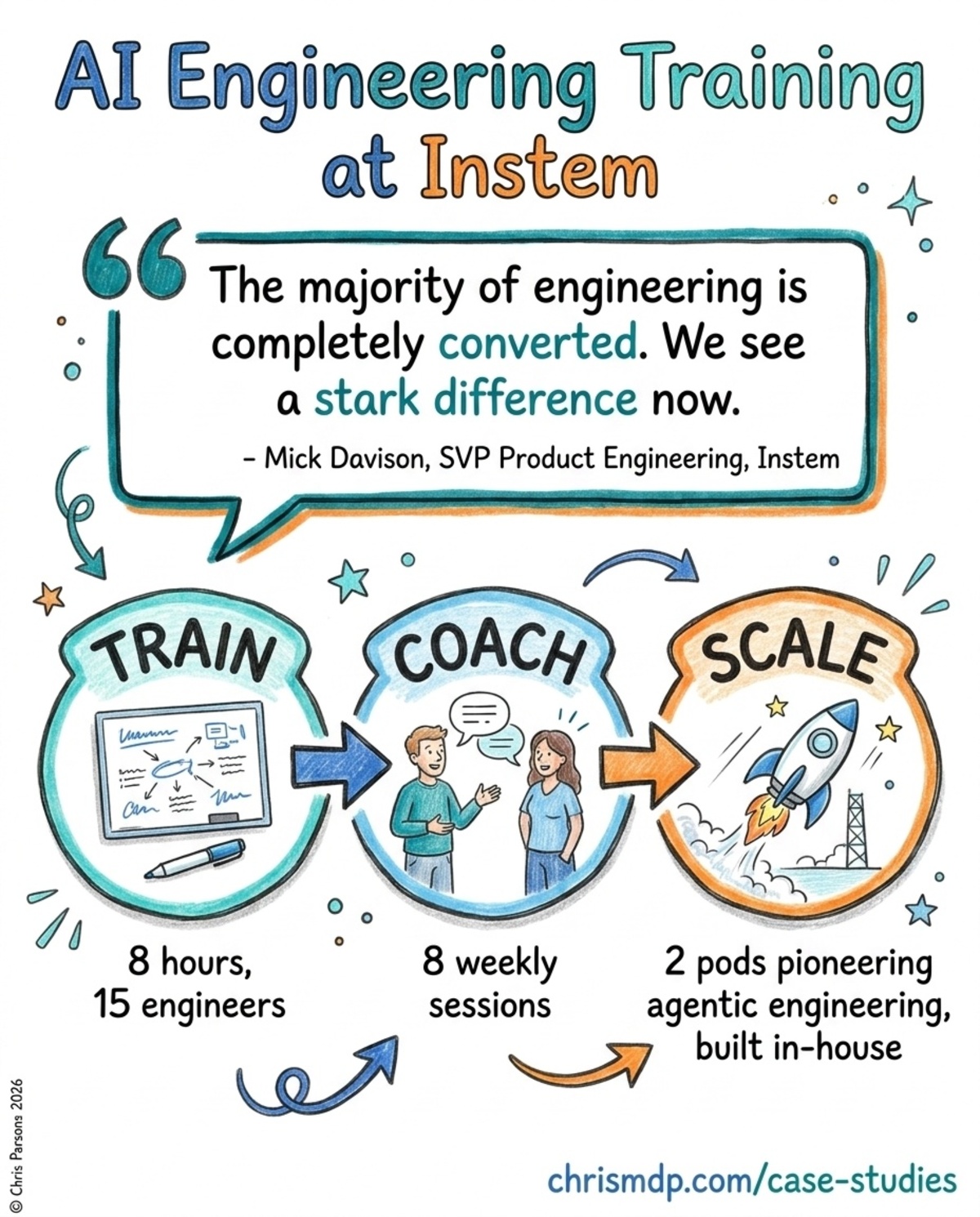
"From where we were in February to where we are now, there's a complete difference. The majority of engineering is completely converted. We see a stark difference now."
Instem builds enterprise software for the life sciences industry. Their engineering teams had seen what agentic tools could do in early experiments, and one engineer had spent two months exploring Claude in depth, but the knowledge was scattered. The question Mick Davison, SVP Product Engineering, was asking was not whether AI worked but how to scale it across fifteen engineers working in traditional scrum teams, running sprint cycles on a large legacy codebase.
Scaling it meant retraining a whole team’s instincts about what a day of engineering work looks like, shifting the bottleneck when coding speed stops being the constraint, and maintaining quality and predictability in a regulated software environment.
We started with eight hours of intensive remote training across a week in February 2026. Exercises were built around Instem’s own codebase and problems, not generic examples. By the end of the first day, engineers were directing agents with custom skills rather than copy-pasting into a chat window. By the final session, a desk booking application had been built from scratch in two days, and a domain-specific skill had caught a real calculation bug in live code during a live demo.
"I've done what was scheduled to be a month and a half's worth of work in three days. It's worked extremely well."
The shift in the first coaching session set the tone for everything that followed. Engineers who had been quiet throughout the training week showed up having made real progress on their own. Mark Jaggers reported shipping new API endpoints in three days that had been scheduled as a month and a half of work. Others in the group had been building quietly too, and what emerged in those sessions was less about technique and more about momentum.
The weekly sessions continued over the following two months, working with a smaller group of key adopters across two engineering pods. The work moved from foundations to real production problems. One engineer used agentic tooling to reverse-engineer a Provantis desktop application into a full documentation site: features, workflows, and a complete persona matrix. That documentation was then fed back in to plan a label management system. A product manager on the team built a clickable prototype in a single day. Colby Dilks built an Azure DevOps CLI security toolkit, then a team skills marketplace. Mark’s team ran an objective assessment of a new product line RFP and identified exactly which parts of the brownfield codebase were good candidates for agentic acceleration and which needed a different approach first.
"Transformative, because it transforms everything that I do as an engineer leading teams. It's not just writing the code; it's transformed the way I think about testing, architecture, managing a team, DevOps, and documentation. Everything's become possible and easier to do now, and it unlocks the ability to think in new ways. There's not really a blocker to what you can do apart from your own mindset."
No single result mattered as much as the calibration that developed across the team. Engineers learned to distinguish between the parts of their work where AI adds immediate leverage and the parts where the surrounding process needs to be in better shape first. Theory of Constraints thinking entered their vocabulary, the team agreed to set up DORA flow metrics to replace guesswork with evidence, and the case for feature flags and continuous delivery over long-lived branches took hold. The team started to make evidence-based decisions about where to apply AI, rather than reaching for it by default.

"All my thinking goes towards more interesting problems now, and I find that really liberating."
Forming the two pods was a deliberate bet on pioneering these techniques in-house. As word of the reverse-engineering result spread, other engineers wanted in, and leadership declined all external vendor responses to a large product RFP because internal progress had already exceeded what those vendors were proposing.
Want to build an engineering team that compounds its AI capability? Chris works with organisations to take AI experiments and scale them across the whole team, from first training through to ongoing coaching and advisory. All training is built around your codebase, your bottlenecks, and where your team is right now.
From experiments to engineering velocity
Get AI training and coaching built around your team's real work. Fill in the form to get started: