I am just back from a family holiday, and the model releases that happened while I was away show that AI models are becoming interchangeable faster than AI strategies can keep up. If your AI strategy is a bet on one vendor’s model staying ahead, think again: whatever intelligence you are paying for today, every competitor you have will be able to rent next quarter. And if you run a normal business rather than an AI lab, that changes your budget, not your ambition.
Two labs had models scoring above 50 on the Artificial Analysis Intelligence Index in early June; six weeks later, six do, sitting within a few points of each other.1 Anthropic now offers Opus 5 as the default on its Max plans at half Fable 5’s API price for near-identical capability,2 and Kimi K3, whose open weights were released on 27 July exactly as promised, has all but caught Opus.3
Capability is converging, prices are falling, and the lead changes before the last winner has cleared procurement. Once capable intelligence is widely rentable, the interesting questions are about your business, not the technology: which customer to serve, which problem to solve, how the work fits, what you learn, and why anybody trusts you.
Intelligence Is Crossing Borders
How intelligence moves between labs and across borders determines two things for your budget: how fast prices fall, and how little exclusivity your money buys. Across the US and China, six suppliers now sit in a narrow capability band, and their ranking changes with the task, the software around the model, and the benchmark. One lab will still discover a new technique, train a bigger model, or unlock work the others cannot do, but the commercial window on each lead keeps shrinking.
Competition between labs narrows the gap, and the product itself speeds things up: intelligence is sold as answers, and answers are easy to copy and hard to contain. That pushes prices down and reshapes geopolitics.
The United States can restrict chips, API access, and companies, but a model response can be bought, copied, pooled and moved. Open weights are harder still: once they have crossed a border, they cannot be recalled.
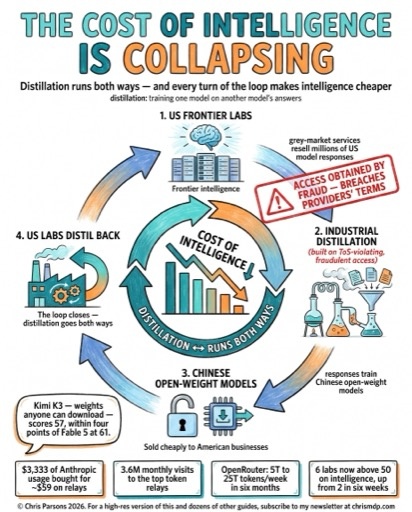
Matt Lenhard’s investigation into the Chinese token relay market shows what markets build when a valuable digital product is scarce, easy to move, and priced differently across borders.4 (No legitimate company should touch this market.) The market runs from card and account merchants, through account pools, into relay shops that sell ordinary-looking API access. One price comparison offered the equivalent of $3,333 of Anthropic usage for about $59, and the ten largest relays Lenhard tracked attracted 3.6 million visits a month.
Some supply comes from free trial abuse, chargebacks, stolen cards, and harvested credentials. Buyers seek cheap model access, ways around regional restrictions and, according to forum participants, responses they can use to train other models. Forum boasts are not audited evidence of who distilled which model (some in the US claim Kimi K3 was distilled from Fable 5, though that is disputed on timing alone), but the relay infrastructure is documented, and it shows an industry already set up to buy model answers in bulk and sell them on as training material.
Scarcity Flows Both Ways
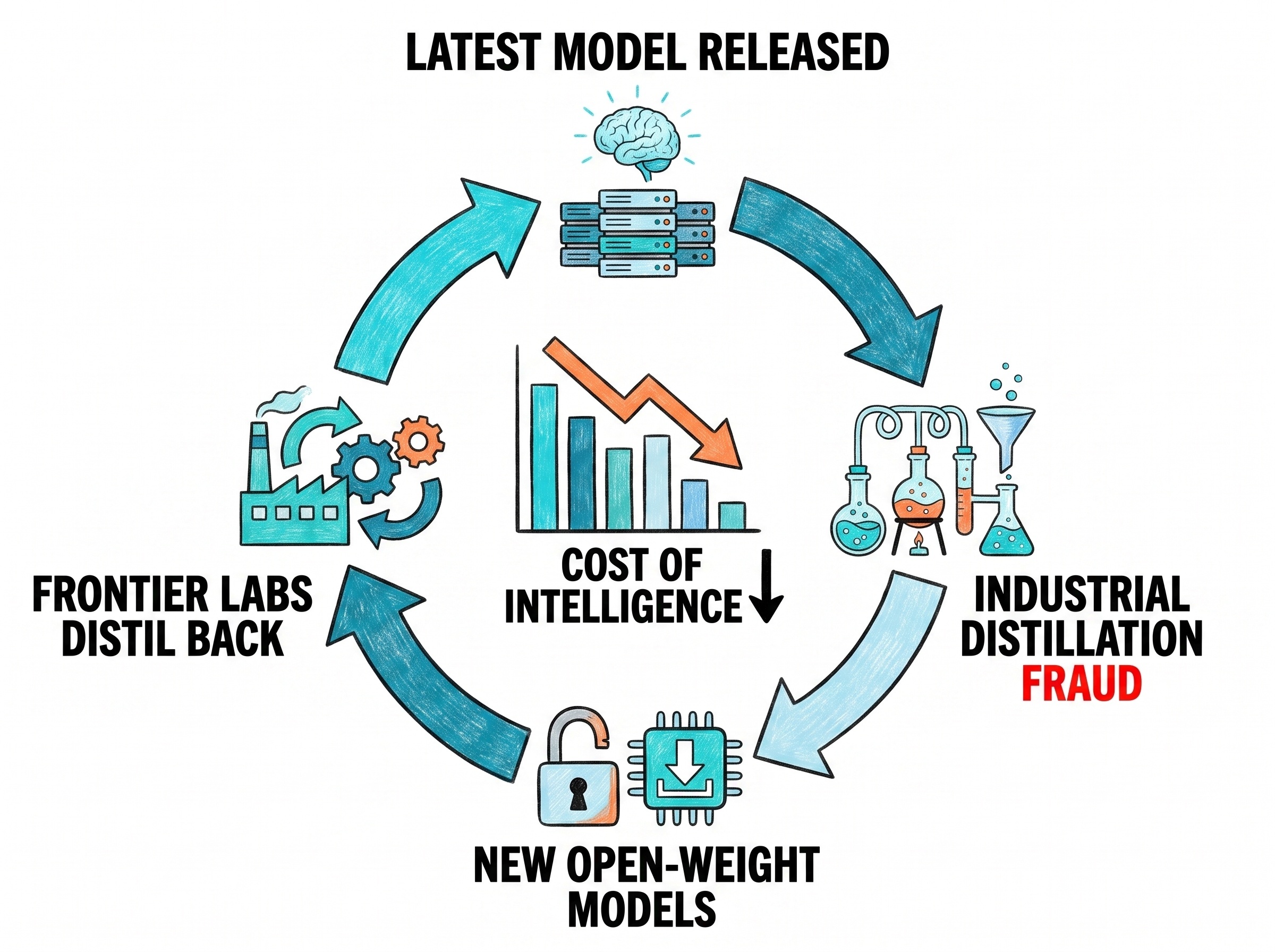
The result is a two-way loop: frontier intelligence can leave US labs as millions of responses via the relay market, while competitive Chinese open weight models flow back into Western products and infrastructure. Distillation now runs in both directions: relay-bought responses help train open weight models, and frontier labs distil strong open models to make their own faster and cheaper. Each direction erodes scarcity: access to closed models becomes harder to police, while access to strong open models becomes cheaper and more portable. Every turn of the circle pushes the price of intelligence down.
The tooling that shrinks these models is racing ahead as well: KTransformers, a research project from Tsinghua University, now runs frontier-scale open models on a single 24GB graphics card.5 Frontier-scale open weights used to imply a data centre; increasingly they imply a workstation, another step in the shift towards unmetered local AI. When I wrote in May that open models are ready, the models were already good enough; the open question was cost, and the hardware bar has kept dropping since.
Governments can make that diffusion more expensive, but they cannot create a durable border around useful answers, and no government controls the whole loop. The legitimate market is adapting too: as models become more substitutable, routing, policy, and payment layers such as OpenRouter become more valuable. OpenRouter grew from 5 trillion to 25 trillion tokens a week in six months, and as models converge, the broker that routes spend across them starts to look like payments infrastructure.6
Own the Learning
Intelligence will not be scarce in the future, so what will your company do with it?
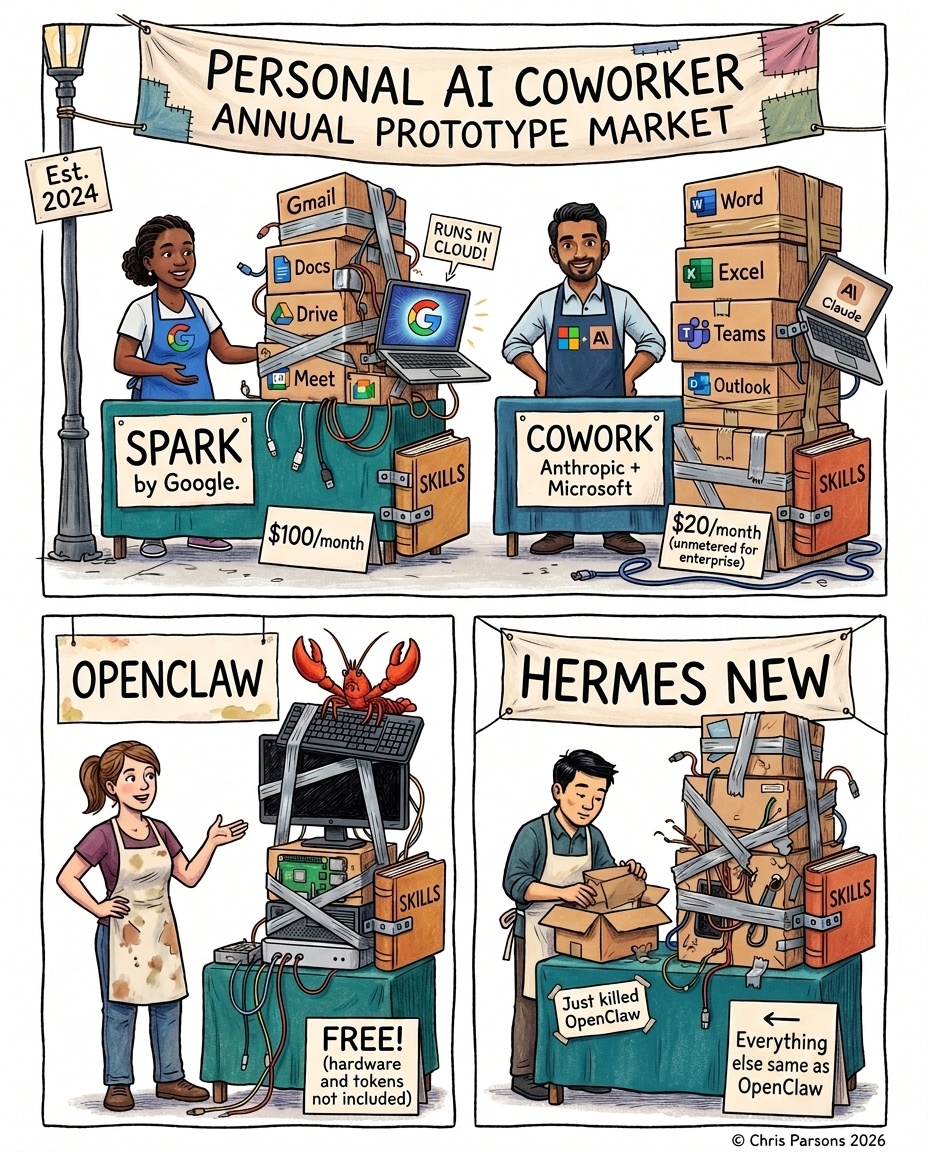 AI are still very much in the prototype stage.
When code, analysis, research, and content become much cheaper to produce, advantage moves into deciding what should exist, knowing which customer has a problem worth solving, understanding the awkward edge cases, fitting into a real operation, earning distribution, building trust, and learning faster than everybody else.
Work used to hide weak thinking because producing anything was expensive; now you can discover that you chose the wrong problem much faster, which makes feedback the new bottleneck.
The most AI-forward organisations like OpenAI, Google and Anthropic are clearly demonstrating this - they have unlimited access to the best AI models, yet their products still have a long way to go. They all still feel like prototypes of the future and tech demos, not the final thing.
The durable asset is the learning loop around the model: customer access, problem framing, workflow data, private evals, corrections, distribution, and trust. If a competitor can use the same model next quarter, those are the things that can still be yours.
The CEO must still choose which customer matters, whose interests count, and what risks are acceptable. Build a stronger learning loop now and you will have something useful to automate later, however often the model changes.7
The Bet You Are Actually Making
Whether AI keeps improving at this pace or levels off, you do not need to know which curve intelligence is on to act this quarter. If capability keeps compounding, frontier spend becomes ongoing team learning: you keep paying to learn what the newest models make possible. Prepare for disruptive change, but do not treat access as an advantage, because your competitors can rent the same frontier. If capability flattens into an S-curve, the intelligence you use today collapses in price, and what you spent was a one-time transformation cost.
In both branches the same posture wins: keep your optionality, and do not sign anything that assumes today’s prices or today’s leaderboard persists. I set out the practical hedges in Escape the Great AI Lock-In. Spend deliberately on learning now: fund a group of pioneers first, as I argued in What CEOs Must Do Next About AI, then decide how widely to train everyone else based on how fast you want to move.
And in both branches, defer the irreversible decisions: large-scale cuts, long lock-in contracts, and sweeping data commitments made before you have learned how AI fits your business are bets placed before looking at the cards. Deferral only works if the learning is in motion, so fund the pioneers now and revisit those decisions once they have results to show. Wait two years for cheap intelligence instead and you will save on tokens, but you will have lost two years of institutional knowledge about how to take advantage of it.
What Would Still Be Yours?
Ask your team this question: if this capability became 90% cheaper and every competitor had it next quarter, what would still be ours?
Good answers include customer relationships, proprietary workflow data, private evals, trusted distribution, regulatory permission, and a feedback loop that improves with use. “Our prompt”, “our wrapper”, and “access to Model X” do not survive the test. I suspect the strongest answers will be about customers rather than technology.
-
Artificial Analysis reported the frontier expanding from two labs to six in six weeks in Four frontier launches in eight days. The current scores: Fable 5 at 61, Opus 5 at 60, Kimi K3 at 57, and Grok 4.5 at 54 at a fraction of the cost per task. Look at the collapsing distance between suppliers in the US and China rather than the ranking. ↩
-
Anthropic describes Opus 5 as the default on Max in Introducing Claude Opus 5, and Artificial Analysis compares it with Fable 5 in Opus 5: Fable 5 level intelligence at a lower cost per task. Premium intelligence can be repriced within weeks. ↩
-
Moonshot AI published the model details and open weight release in Kimi K3: Open Frontier Intelligence. A 2.8 trillion parameter model: at this scale, openness gives buyers deployment and bargaining rights rather than ordinary laptop inference. ↩
-
Matt Lenhard documents the participants, economics, and traffic in An Inside Look at the Relay Market Powering Token Resellers and Fraud. The clearest picture I have seen of the economic machinery that forms when valuable intelligence is metered but its outputs can move freely across borders. ↩
-
The KTransformers project, from Tsinghua University’s MADSys Lab and Approaching.AI, splits mixture of experts models between CPU and GPU, keeping the busiest experts on the GPU and parking the rest in ordinary system memory with INT4 and INT8 quantisation. That puts DeepSeek R1 class models on a single 24GB GPU, with day-zero support appearing for each new Chinese open weight release. ↩
-
OpenRouter reported its growth from 5 trillion to 25 trillion tokens a week in six months in its Series B announcement. ↩
-
Even useful learning may not stay scarce for long. AI can already run structured interviews, cluster transcripts, propose changes, build software, watch usage, and prepare the next experiment. How long before it can interview customers en masse and build the next version too? For now, though, a working learning loop is rare. ↩
High-res version available to newsletter subscribers