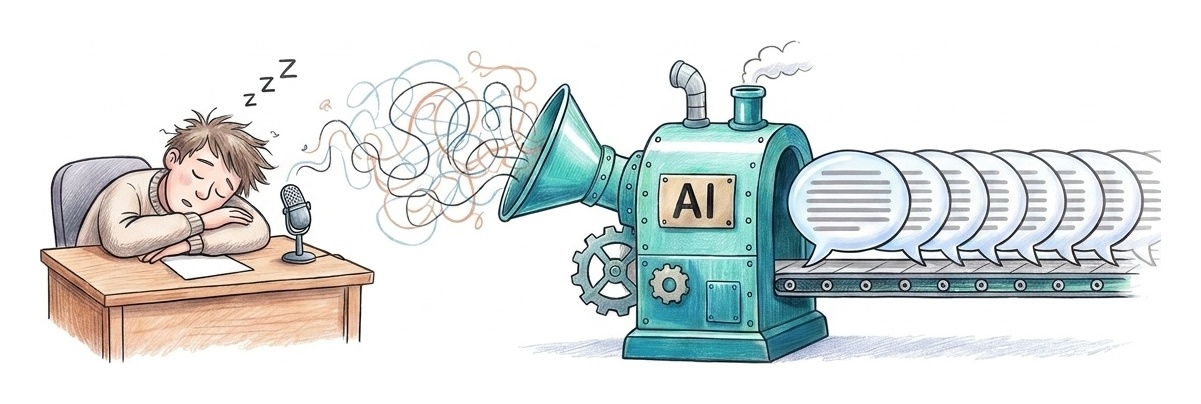
For thousands of years we have treated writing as proof of thinking. You could not produce a fluent, well-argued piece without doing some thinking along the way. That is no longer true.
Large language models (LLMs), the engines underneath most AI agents, are born to write. Writing is how they reason about the problems we give them, and it is how they talk back to us. Fluent words now cost almost nothing, and we have to build a new mental model of writing: words do not mean thought.
When people use thought-free output verbatim, the result is slop. LinkedIn shows the problem well: since ChatGPT launched, the average long LinkedIn post has more than doubled in length.1 I very much doubt the thinking inside those posts has doubled too. Worse, slop does not just sit there. People read half-formed, average ideas, copy them into their own notes and repeat them, and the research suggests that AI editing shifts what people conclude, not just how they phrase it.2 Ideas get diluted and proper thought gets stifled, the vicious cycle I wrote about last year. Shopify’s CEO Tobias Lütke has a name for the workplace version, slop grenades: AI-generated emails and code that people toss at each other without reading or understanding them.3 The author saves time, and their colleague has to do the thinking instead.
How do we get out of this mess? By remembering that writing was never just about producing words. The words are the output. The thinking we do while we write is what matters, and readers can tell when it is missing. This article is about how I use AI to write, and how I try to let it speed me up without skipping the part that adds value.4
Writing Is Where Thinking Happens
Some writing is slow and painful. It is the forging and fusing of our thoughts with the words that appear in front of us. It takes honing, editing, and ruthless cutting down to the most succinct version of what we think. The product is a polished set of thoughts that adds something to a debate. Tara Seshan, who leads product for Codex and ChatGPT Work at OpenAI, calls this writing to think, as opposed to writing to report.5 When you write to think, the writing is where your position gets formed. When you write to report, you are converting thoughts that already exist from one form into another, such as code into documentation, or a set of ideas into a LinkedIn post.
AI is brilliant at converting thoughts and very bad at coming up with original ones. The danger is that it converts so well that you do not notice the original thinking has been skipped.
I have a confession about this. I caught myself doing exactly this in my early days of writing with AI, because I had not really thought through the difference. I would dictate a stream of consciousness, let the AI polish it up, and send it. But a stream of consciousness is not a well-formed thought. What came back was 90 percent good enough, but it was not any good, because it was not my formed thoughts. Some of my earlier articles are scattershot and do not always hang together. They were first drafts, polished and tidied to look like more than that (I have since cleaned up a lot of them on this site, but you might still find some if you look hard enough!) Polished unformed thoughts are the worst kind of writing, because the polish hides the gap from the reader and from you.
This is also why slop feels so empty to read. We are wired for story and meaningful connection, and the content people share most is the content that makes them feel something.6 When we read, we feel connected to the writer’s inner world, and we process our own thoughts alongside theirs. If we sense that an AI was involved to the point that the words are no longer the author’s creation, we feel flat and hollow, as if there was nobody on the other end.
When AI Should Write It
This does not apply to all writing. A letter to the council complaining about a parking fine is very different to a quarterly strategy.7 What matters is what the writing is supposed to carry, and whether that part has to come from you.
Some writing only carries information. Translating a document, turning code into documentation, or reshaping a company policy into a handbook all move meaning from one form to another. That is barely writing at all, in the same way that heating something up is not really cooking.8 If no original thought happens in the process, it is a waste of time not to use AI.
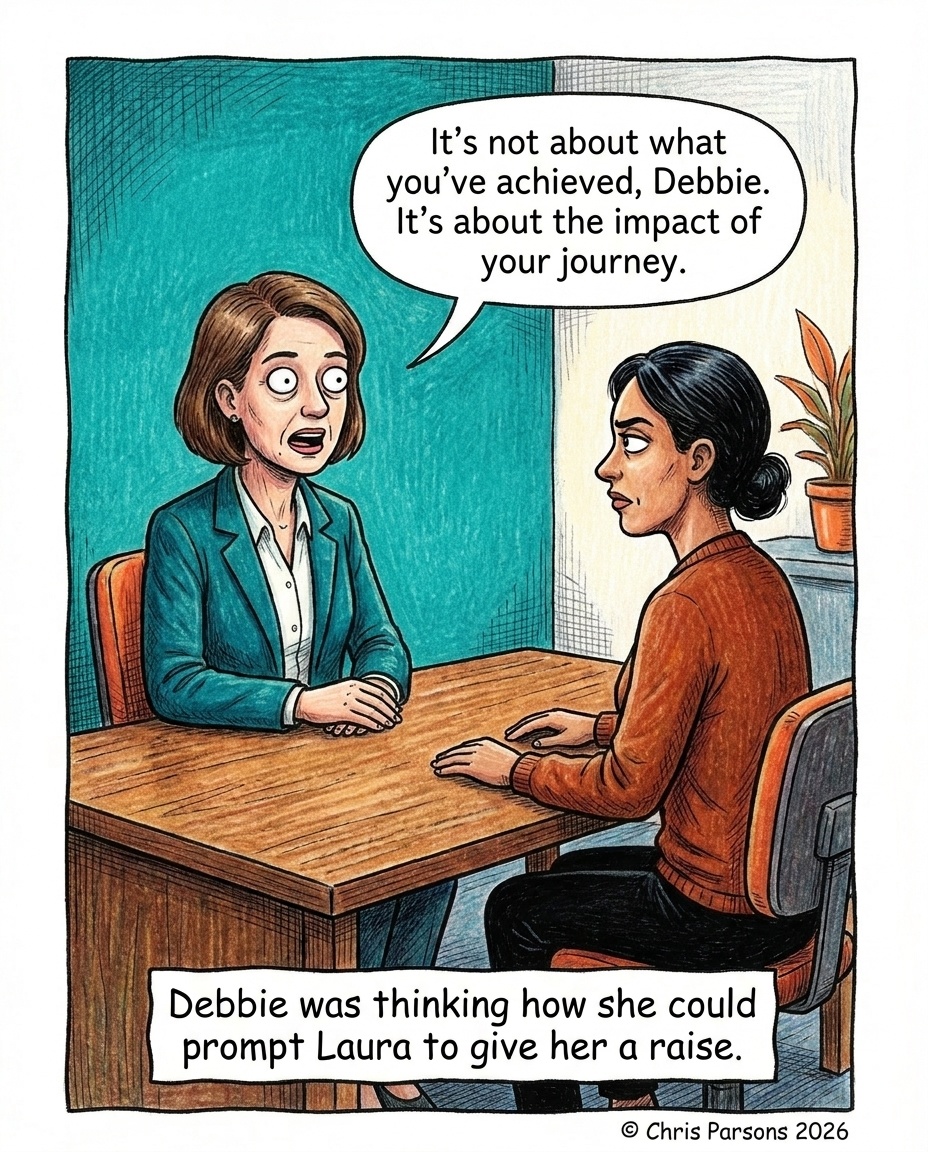
Some writing carries ideas you have already formed. I write a lot of posts on LinkedIn, and I do not mind AI helping turn a set of ideas I have already thought through into another format. The infographics I make for my posts are the same: they convert an argument I have already written into a picture, so I am happy for AI to draw them. Comics are a bit different. A good comic makes a joke or lands a point in a single frame, and getting that right is thinking in its own right. I often go through fifteen rounds of revision before one works, and I keep the whole provenance chain for each one: every prompt, every rejected draft and every correction I made along the way.
That does not change the fact that there is a huge amount of slop on LinkedIn. The slop is created too quickly by people who haven’t thought through what they’re saying. I do not care who wrote the words, but content built on ideas people have not come up with themselves adds nothing. It is just noise. The same goes for comments. Automated commenters are farming engagement, and they produce the worst kind of slop.
Some writing carries you. Creative writing that weaves story or meaning is an expression of self, so you need to have thought through the content and stand behind the meaning and intent of every word. Writing to build a relationship goes further still. If I am trying to connect with someone, or tell them how I feel, there is no place for an LLM in forming those thoughts. There is a big difference between a quick follow-up to schedule a call and a letter written from a place of deep feeling. I have no problem with AI doing the first. Using it for the second tells the other person I do not care about them. There is also a difference between using AI to send cold emails at scale and sending a thoughtful note about something that made you feel a connection with someone. That second note is not logistics. You are trying to build a personal connection, so write it carefully. At the very least, let the AI give you the bones and edit them until they are really yours. My friend Hywel Carver has a good test for this: would you be comfortable telling the other person you used AI? If not, that discomfort is your empathy talking, and you should probably write it yourself.
How I Write Now
What I care about is whether people did the thinking, and whether they meant it when they claim to be expressing themselves or connecting with me. So when a piece needs real thought, or someone is paying me to think through a problem, I make sure I go through that process myself.
I start by asking an AI to pull up everything I already know about the topic. I keep my notes, meeting transcripts and saved articles in a folder my AI can read, so it can find what I said in a meeting three weeks ago, or the voice note I recorded after listening to a podcast. It gives me that back as bullet points. I had been collecting thoughts for this post for a few months, so it surfaced meeting notes, voice notes arguing both sides of the question, and articles I had saved along the way.
Then I hold as much of that in my head as I can, and write the argument myself, either typed or dictated. When I do want help with structure, I ask for an outline rather than a draft. Something like: “From this, give me a structure. Do not write the prose. List the argument, the open questions, and what is missing.” Then I write it up myself. Doing a comic first is a useful forcing function. My comics tend to be good precisely because coming up with the premise forces me to decide what I actually think.
The thinking does not always have to happen at the keyboard. Sometimes it happens in conversation. If I have already worked through a set of changes with someone on a call, I am happy for an AI to apply them from the transcript. Making all those edits by hand is only worth it if I want to think them through again.
Once I have a draft, I refine using an AI. I ask the AI what it thinks my argument is. On the first draft of this post, it told me the title promised one argument and the body made another, and that my best paragraph was buried at the bottom of a list, and it was right, so I rewrote the structure and only then did I let it help tidy the prose. I fact check and chat to the AI about various sections or things that feel “off”.
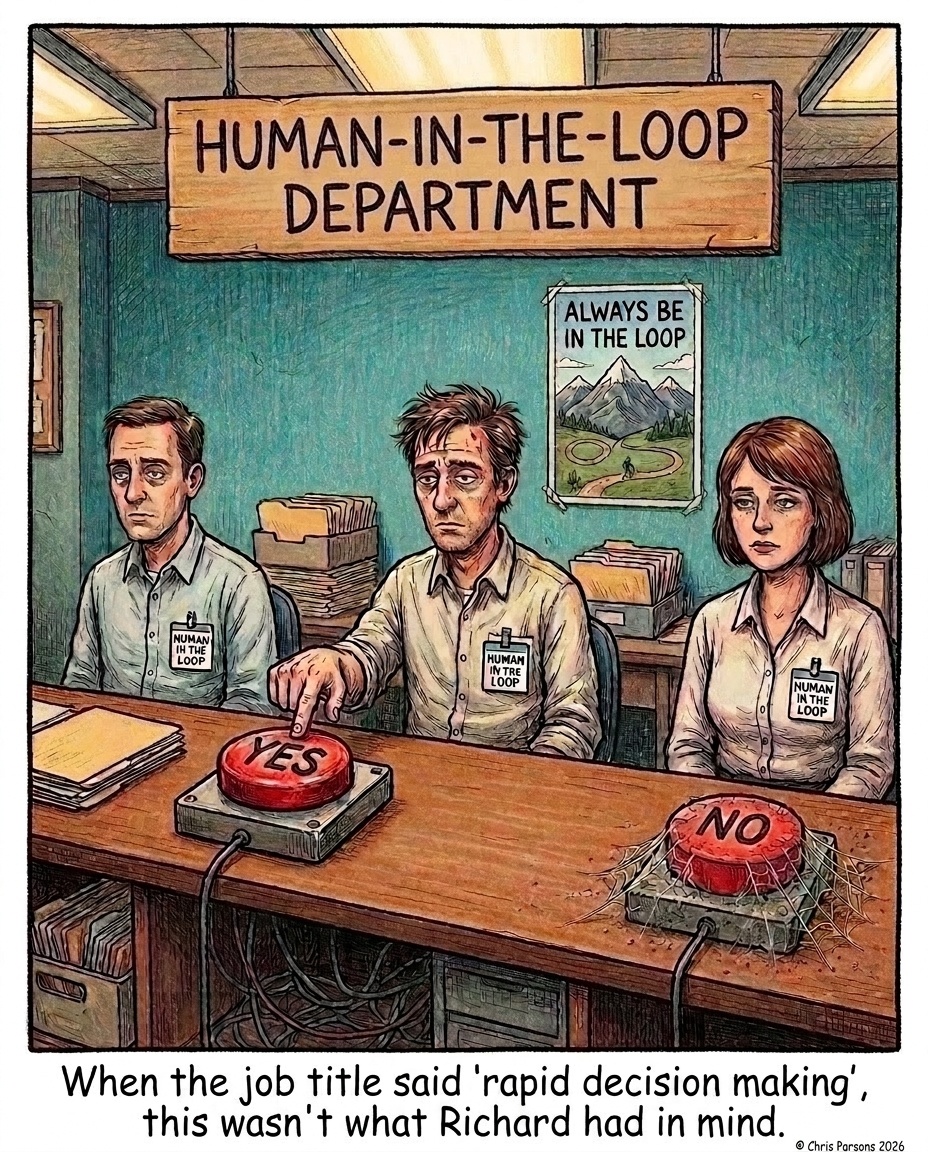
Finally, I read every line and ask myself whether I stand behind it. Some writers go further than this. Thomas Ptacek will not use a single word an LLM suggests, because the phrasing carries a style you can smell.9 I can see the appeal, and it is a reasonable rule if you want it. My line is looser: the ideas, the evidence and the judgement have to be mine, and I need to recognise the meaning of every sentence.
Keep the Receipts
There is a legal reason to do the thinking yourself, too. Copyright law protects human authorship, and it is not yet clear how much of an AI-assisted piece counts. The US Copyright Office says prompts alone will generally not make you the author, but your own selection, arrangement and editing of the output can be protected.10 In the UK, the law has a rule for computer-generated works that predates generative AI and has never been properly tested on it.11 If the machine did all the creative work, you may not own the result in any meaningful way.
That is why I keep provenance records for my comics and infographics. The record is not a guarantee of copyright, but it is evidence of what I contributed: the idea, the choices, the corrections and the drafts I threw away. The same logic applies to writing. If your first draft, your outline and your edits are your own, you can show where your thinking went in. If all you have is a prompt and a polished output, you cannot. (This is practical information, not legal advice.)
Stand Behind Every Line
Companies are starting to write these policies down. The best AI writing policy I have seen is Clay’s, written by Sophie Alpert.12 It has four principles:
You must stand behind every idea and every sentence in your docs, and “AI wrote that, just ignore it” is not an acceptable answer.
Writing is thinking, so outsourcing it to skip the thinking defeats the point.
More time should be spent writing a document than reading it, because one author’s effort saves time for many readers.
Longer is not better. You have probably heard that Blaise Pascal once apologised for a long letter because he had not had time to write a shorter one.13 AI writes the longest version of all, in the quickest time.
The policy even allows quoting AI directly, as long as you say so: “Claude suggested this, what do you think?” is honest and useful.
I would add one thing from my own experience: develop a slop allergy. People who are new to AI often cannot spot content free writing, because it looks so polished. With practice you start to see the shape of it before you have read the words. Get to the point where you would be embarrassed to send it.
Make sure your team are thinking, the simplest way to do this is to ask them what they think about a piece of their writing, and how did writing this help you get there? It will become clear quickly whether the thinking has been done. Do not judge people for using LLMs to write. They might be tidying up their English, or their spelling. Judge the thinking behind the writing on its merits.
Fluent words are free now, but thinking is not, and thinking is still the reason anyone reads what you write. AI is brilliant at converting thoughts and very bad at coming up with original ones, so give it thoughts worth converting. Do the thinking yourself, let AI help with the rest, and stand behind every line.
-
Originality.ai examined 8,795 long LinkedIn posts (100 words or more) from 2018 to 2024 and found a 107 percent jump in average word count since ChatGPT launched, as reported by The Register. ↩
-
The LLM writing distortion study found that when models revise human writing, they shift the argument and its conclusions, not just the style, and push everyone in the same direction. LLMs homogenise writing. ↩
-
Tobias Lütke on The Knowledge Project podcast, as reported by Fortune: Shopify CEO says employees’ ‘slop grenades’ are making more work for everyone else. ↩
-
Tara Seshan on Lenny’s Podcast: AI’s third era: the rise of persistent AI coworkers. ↩
-
Jonah Berger and Katherine Milkman studied around 7,000 New York Times articles and found that content which stirs high arousal emotions, such as awe, gets shared most: What Makes Online Content Viral?, Journal of Marketing Research, 2012. ↩
-
The Economist makes a similar contrast between contesting a parking fine and writing an apology: AI often makes writing worse. (Even if it makes it better). ↩
-
If you want to do some proper cooking rather than heating things up, Cherrypick plans your meals and fills your supermarket basket with everything you need to cook them. I co-founded it, so I am biased :) ↩
-
Simon Willison quoting Thomas Ptacek: How to write with an LLM. ↩
-
US Copyright Office, Copyright and Artificial Intelligence, Part 2: Copyrightability, January 2025. ↩
-
Section 9(3) of the Copyright, Designs and Patents Act 1988 says the author of a computer generated work with no human author is the person who made the arrangements necessary for its creation. ↩
-
Sophie Alpert, Clay’s AI writing policy, 19 August 2026. ↩
-
Often attributed to Oscar Wilde or Mark Twain, but it was Pascal, in the sixteenth of his Provincial Letters (1657): “I have made this longer than usual because I have not had time to make it shorter.” ↩
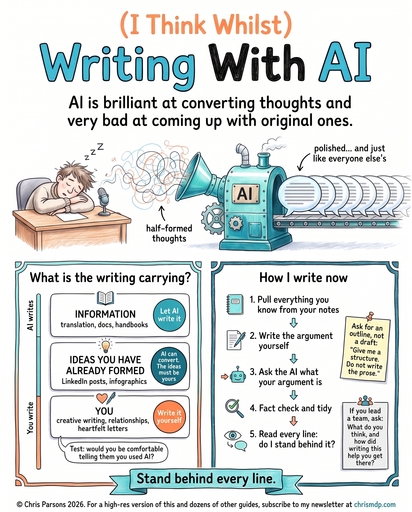
High-res version available to newsletter subscribers