Past Talk
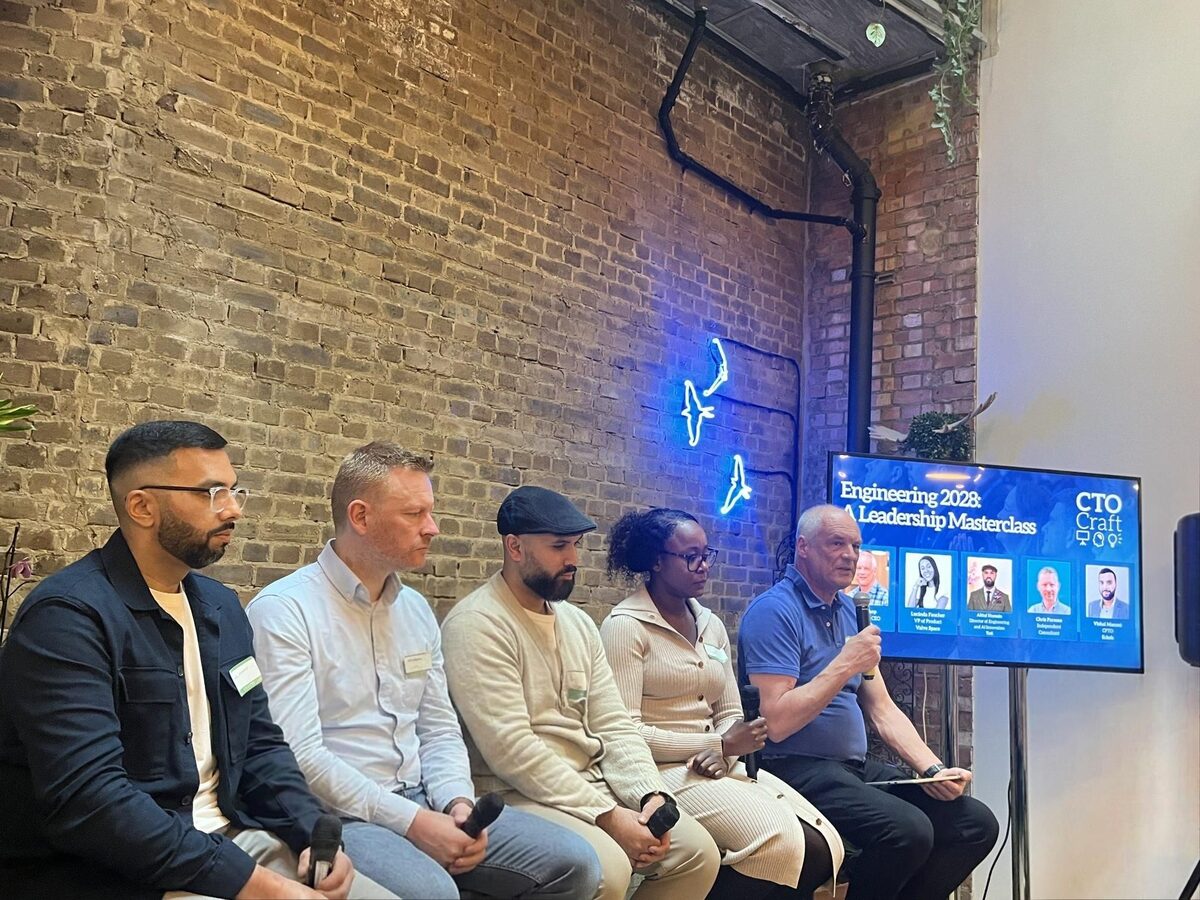
When CTO Craft and Damilah asked me onto their “Engineering 2028: A Leadership Masterclass” panel, I put my hand up to be the one who disagreed. Every good panel needs someone willing to take the other side, and I would rather generate a bit of useful friction than watch five people nod along.
The evening brought a room of engineering and product leaders together at Wallacespace in Clerkenwell, chaired by Iain Bishop of Damilah, with fellow panellists from Yoti, Eckoh and Valvespace. Iain moderated with a set of open questions, and the sweet spot was two of us per question, ideally disagreeing, so it moved quickly and stayed honest.
The questions cut to what actually changes for engineering leadership as AI and orchestration mature: what has genuinely shifted rather than what the vendors claim, where the boundary sits between what humans decide and what AI executes, where a leader should even start, what goes wrong and how you protect quality when code becomes cheap, and how you measure success when your old delivery metrics stop telling the truth. The one I pushed hardest on was governance and accountability, because when an agentic workflow ships something that causes harm, there is still a human whose name is on it. The EU AI Act is coming, and boards are nervous about exactly who that human is.
The Winners Won’t Have the Best Engineers
The companies who win by 2028 will have the clearest architecture and the most codified sense of what “good” looks like. Most teams feel like they have survived AI, but they have only survived the autocomplete phase. The next wave does not slot neatly into your workflow the way Copilot did, it replaces the workflow, because an agent that holds context across the codebase, plans multi-step changes, runs its own tests and ships overnight is a different model of software delivery. Briefing, constraining and verifying those systems is the new skill.
That changes what a senior engineer is for. Implementation stopped being the differentiator about a year ago, so every engineer is becoming a kind of staff engineer, judged on systems thinking and the ability to specify what good looks like rather than on how fast they type. The taste they have spent years building, knowing what clean code looks like and where the tech debt will bite, is now the scarce input. Senior engineers who feel left behind are being promoted, not displaced, and the job is to externalise that judgement into documents, review agents and standards a machine can act on.
It also changes team shape: make your teams smaller, not hybrid. Keep the developer, the product person and the designer as a real triad and let AI handle everything else, rather than dissolving the disciplines into one overloaded generalist. Hybridisation looks efficient and quietly rots the design systems and diverse thinking that good products depend on, a point I go into properly in my tortoises not hares write-up. Underneath all of it, fix your foundations first, because good linting, tests and CI are what stop agents producing technical debt at machine speed.